Despite ongoing partisan politics, the vehicle electrification movement faces major structural challenges. High costs for installing fast-charging stations and an outdated, overloaded grid unable to support fast-charging technology in many areas are significant obstacles. However, the EV charging landscape is improving with the introduction of AI-assisted charging-plus-storage systems, as demonstrated by California startup ElectricFish.
EV Charging In The USA: Where Have All The EVs Gone?
The rollout of new EV charging technology in the US comes at a difficult time for decarbonization advocates. As expected, domestic EV sales dropped sharply after the federal EV tax credit ended on September 30, 2025, and the outlook for 2026 remains uncertain.
Still, EV sales have not disappeared entirely. Automakers like Toyota, Ford, newcomer Telo Trucks, and the Jeff Bezos-backed startup Slate Auto are planning to introduce new EVs, filling the gap left by Tesla’s decline. Their efforts support the idea that investing in the nation’s EV charging network remains worthwhile.
While the loss of the tax credit may deter some current EV owners from purchasing another EV, over 4 million EVs are already on US roads. Many of these drivers are likely to choose another EV when it’s time for a new car, further justifying investments in charging infrastructure. Additionally, sales of plug-in hybrids, including range-extended models from Scout Motors, will continue to drive demand for more accessible charging stations.
The ElectricFish Solution: Go For The Gas Stations
ElectricFish offers an affordable EV charging station solution that bypasses grid bottlenecks, focusing on helping traditional gas stations add EV charging to their services.
“Gas stations are built for short dwell times and high turnover. We designed our new service to behave like a pump, not a parking space,” says ElectricFish CEO and co-founder Anurag Kamal.
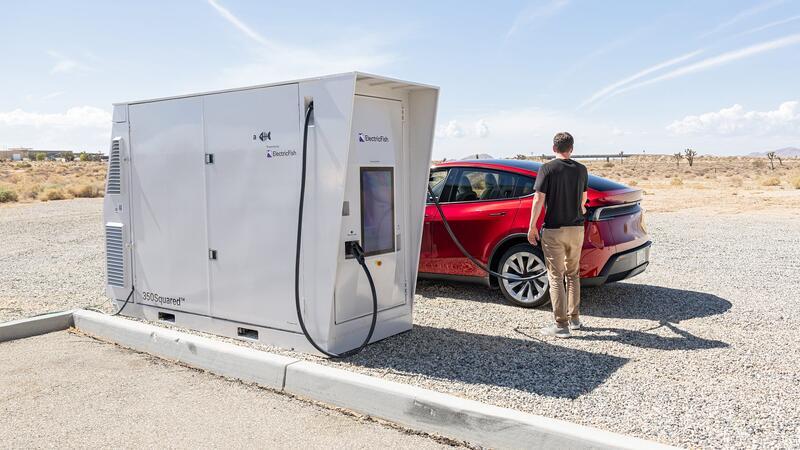
ElectricFish debuted in March 2025 with its “350Squared” charging station, claiming a 90% reduction in grid upgrade costs compared to conventional fast-charging stations by eliminating the need for new trenches and other infrastructure. The containerized system is also easily relocatable if necessary.
According to CleanTechnica, “ElectricFish’s chief contribution is ‘350Squared,’ a modular, plug-and-play charging station that can use existing 200-amp electrical infrastructure to serve as both a community microgrid and energy storage facility, providing backup power during emergencies.” The ultra-fast charging system includes 400 kilowatt-hours of storage, allowing it to recharge slowly while delivering quick charges to EV drivers.
Recently, ElectricFish introduced its new “400Squared” charging station at the Consumer Electronics Show (CES) in Las Vegas, sharing more details with CleanTechnica.
Convenience is central to ElectricFish’s approach. The goal is to offer EV drivers a quick 8–10 minute top-off at local gas stations, adding up to 180 miles of range, while a revenue-sharing model removes upfront installation costs for property owners.
“Conventional fast charger installations require utility upgrades that can exceed $150,000 per port and take 12–18 months or more to complete,” ElectricFish notes.
“The grid can’t keep pace with EV adoption - and legacy DC fast charging makes the problem worse,” the company adds. “Each new installation adds massive peak demand to already strained infrastructure, deepening the very constraint holding EV infrastructure back. The harder the industry pushes, the more the grid pushes back.”
With integrated storage and energy management software, ElectricFish can deliver 400-kilowatt charging from a 30-kilowatt grid connection, or even less in some cases. Installations can be completed in 4–6 weeks, a significant improvement over the 12–18 months typical for conventional fast-charging stations.
“We don’t sell EV chargers or batteries; we sell time and uptime. We’ve decoupled charging speed from grid limits by actively managing when energy flows in or out, so fast charging strengthens the grid instead of destabilizing it,” explains ElectricFish CTO and co-founder Nelio Batista.
More EV Charging Stations For More EVs
ElectricFish’s solution has already received strong support from Hyundai, which tested the system at its California Proving Ground during the summer of 2025. “We see this as a way to unlock fast charging at sites that the grid alone can’t support today,” said Hyundai Senior Engineer Dean Vivo Amore.
Toyota is also involved. ElectricFish credits the Toyota Mobility Foundation’s Sustainable Cities Challenge for helping with its latest commercial deployment at Detroit’s Eastern Market food and warehouse hub.
ElectricFish is one of several new innovators combining charging and storage, anticipating that today’s challenging EV sales environment is only a temporary setback on the path to a decarbonized future.


.svg)