
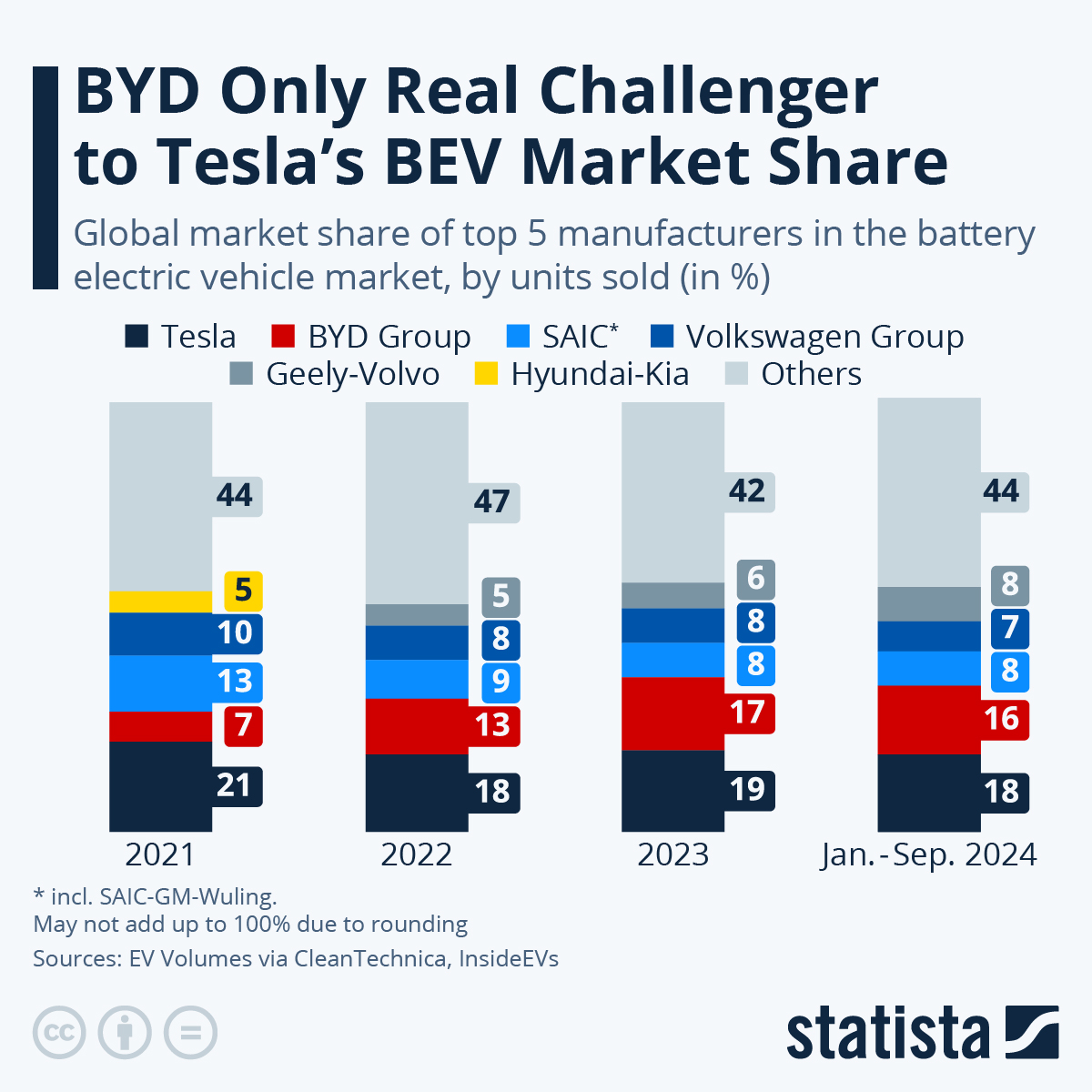
Figures from New AutoMotive show that in the UK, BYD’s year-to-date registrations in November rose by 251.7% compared to the previous year, while Tesla registrations declined year-on-year.
In 2025, Tesla sold 1.64 million EVs, marking its second consecutive year of lower deliveries. This announcement followed news that BYD, the Chinese-headquartered EV-only carmaker, increased its battery electric car sales in 2025 to over 2.25 million.
Tesla’s early dominance stemmed from its first-mover advantage in Western markets, especially in the US, where BYD is unable to ship vehicles due to trade restrictions. However, as BYD has expanded its presence in markets outside China, Tesla’s performance has declined.
New AutoMotive data also revealed that BYD’s UK market share increased by 3.74% year-on-year, while Tesla’s dropped by 2.9%. Tesla registrations in the UK fell by just under 5% over the same period.
Sales of Chinese-made EVs, including brands like Geely, have surged as these automakers, specializing in EVs and benefiting from lower manufacturing costs in China, have undercut Western rivals on price.
This competitive pressure has led legacy automakers in Europe to successfully lobby the European Commission to relax EV sales targets, as manufacturers face challenges transitioning from internal combustion engine (ICE) vehicles to EVs.
As an EV-only manufacturer, Tesla has not needed to retool its plants to meet rising EV demand. However, since the Trump administration returned to power last year, with support from Tesla chief Elon Musk, Tesla has struggled to maintain its lead.
The revocation of tax rebates for EV purchases and charging technology has impacted the entire US EV market. In October, Tesla reduced prices on its two best-selling US models in an effort to boost sales.
While Tesla released delivery figures and reported deploying 46.7GWh of energy storage in 2025, its full financial results are expected at the end of the month and may be bolstered by performance in other markets.
The response of the charging infrastructure landscape to these market shifts will be important to watch.
Tesla EVs were initially released with unique charging port technology, preventing other drivers from using Tesla’s Supercharger network and limiting Tesla drivers’ access to other chargepoint operators (CPOs).
In the US, when the Supercharger network received more investment than competitors, exclusive access to Superchargers became a key selling point for Tesla, especially as public charging options were often oversubscribed or unreliable.
Since then, significant efforts have expanded the US public charging network and opened the Supercharger network to all EV drivers, aided by adaptors and cabling compatible with multiple vehicle types. Other CPOs and EV makers have adopted Tesla’s technology standards: CCS (combined charging system) connectors are now the global standard, while NACS (North American charging standard), used by Tesla, dominates in the US.
As Tesla’s global market share declines, it remains to be seen whether the company will continue to adapt to broader industry trends. The recently opened Supercharger hub in Australia is accessible to all vehicles with CCS2 compatibility, not just Teslas, reflecting a strategy of expanding charging access. Newer Tesla models, such as the Model 3, are equipped with CCS connectors, allowing access to a wider charging network without adaptors.


.svg)