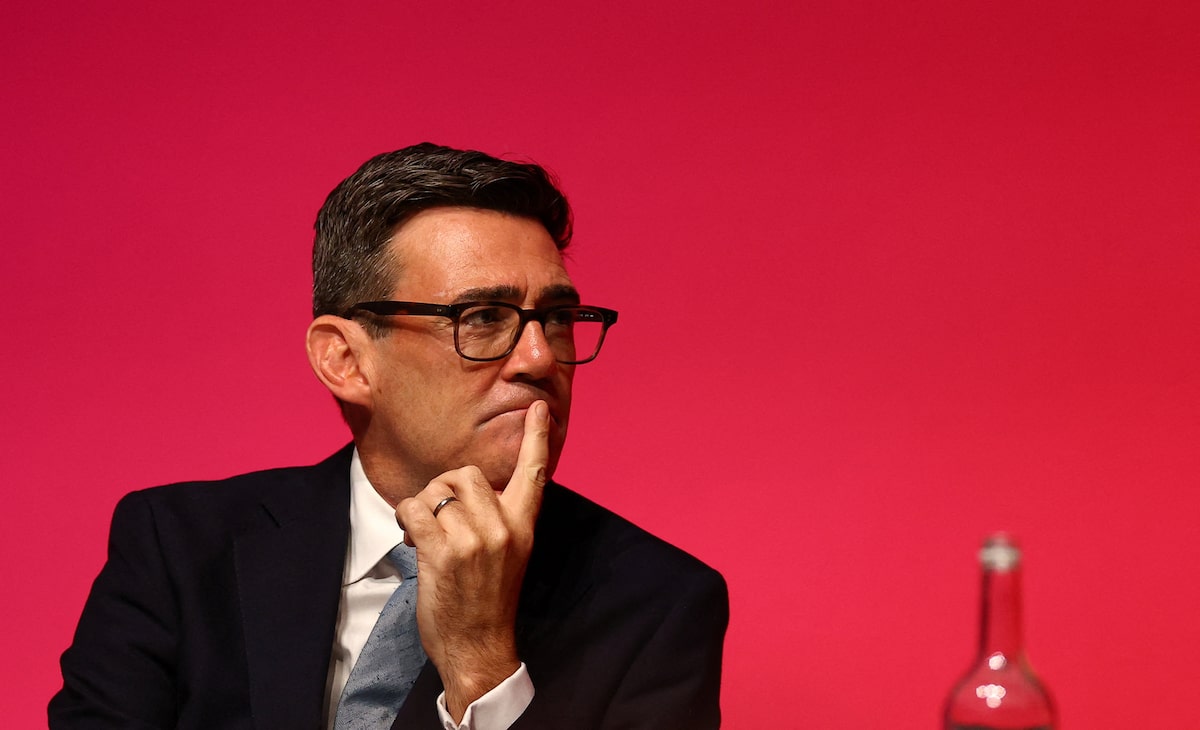
Alongside the £30 million People’s Power plan, UK Prime Minister Andy Burnham delivered what many consider his clearest and most decisive stance on clean energy since taking office.
Last week, the government announced that its Great British Energy company will invest in community energy schemes nationwide.
In an article for the Guardian, Burnham explained that the funding aims “to put money back in people’s pockets while giving them a direct role in tackling the climate crisis.”
His administration has prioritized reducing the cost of living and advancing devolution, both of which are central to the GB Energy funding. Burnham stated that his government will “help people make the change by creating jobs, lowering bills and bringing power back to them.”
He concluded the article by reaffirming: “I am determined that we meet the commitment on which Labour was elected and reach net zero by 2050.”
Burnham’s article marks his most assertive commentary on climate, a topic he had previously addressed less directly. He faced criticism over the summer for not strongly linking successive heatwaves to global warming; in his article, he acknowledged that this summer demonstrates Britons are not immune to climate change.
Trade body Solar Energy UK praised the Prime Minister’s “zest” for community energy projects. Chief executive Chris Hewett said, “The Prime Minister is entirely right to emphasise the role of renewable energy in confronting a warming world and high energy bills while pursuing his goal to reindustrialise Britain.”
However, there is a notable absence of the Clean Power by 2030 mission, which was a prominent feature of the Labour Party manifesto and the government’s previous energy policy.
A shift away from the 2030 target has been anticipated since Burnham took office, with new energy secretary Miatta Fahnbulleh focusing her agenda on reducing consumer costs. She has continued former secretary Ed Miliband’s approvals for large-scale solar power plants, but is also rumored to be considering consent for the Jackdaw and Rosebank oil and gas fields in the North Sea.
Responding to Burnham’s article, former senior advisor in the Department for Energy Security and Net Zero (DESNZ) Sulaiman Ilyas-Jarrett commented on LinkedIn that “a willingness to put political capital behind the issue can only be a good thing.”
This is particularly relevant after the cross-party Energy Security and Net Zero (ESNZ) Committee published a report on the same day as Burnham’s article, arguing that the term ‘net zero’ has “lost much of its significant positive association.”
When the UK’s commitment to achieve net zero by 2050 was written into law in 2019, it represented a rare moment of political consensus during a period of deep division over issues like Brexit.
Since the last election, political support for clean energy and net zero has declined. Reform UK has pledged to rescind ‘net stupid zero’ policies, and the Conservatives, who were in power in 2019, have also retreated from their previous positions.
While concerns remain about the cost of the energy transition and local opposition to infrastructure projects, the ESNZ Committee’s report argues that ‘net zero’ now “acts as a distraction from the broader aims of the energy transition and as a lightning rod for opposition to climate action.”
The report states, “There is a danger that the politics of the energy transition has replaced the previous consensus with a stale discussion on the cost and feasibility of achieving an emissions target. That is reflected in the public debate which fails to reflect the full range of benefits of engaging with the transition or the costs of not tackling climate change.”
In this context, Burnham’s commitment to net zero may be a stronger political pledge than it first appears.
Ilyas-Jarrett also noted that the £30 million funding is being delivered by GB Energy, which already had commitments to community energy. He described the scheme as “repackaged to fit a devolution narrative.”
Under Starmer, GB Energy’s commitment to community energy was known as the Local Power Plan. While Burnham highlighted this commitment, calling the funding a “downpayment on a £1bn Great British Energy programme,” he no longer uses the Local Power Plan title.
It appears that, although he took some time to do so, Burnham will continue the previous cabinet’s efforts. Leaked documents first reported by Sky News indicate that the government has been “borrowing” from Starmer’s plans, relying on policy briefings and timelines developed before Burnham’s leadership challenge.
Given the previous cabinet’s support for the industry, this continuity is not necessarily a negative development.